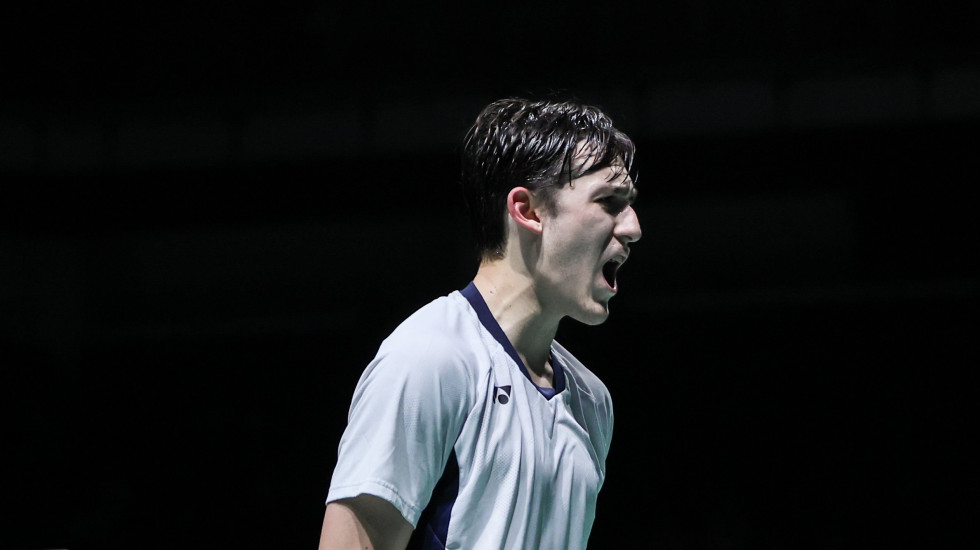
Text by BWF | In Part 2 of the interview, Presley Smith discusses the challenges of transitioning from a recreational background to high-level training in Taipei and adapting to the challenges of elite badminton.
Your story is unconventional. Most players start off competitive training by the time they are eight or nine. How did you adapt?
My problem has always been the physical aspect. Even now, I feel I’m way behind the top players when it comes to the physical (aspect) because I didn’t do it as a kid. But because I was so not good with physical training, I adapted my skills a lot better, my hand skills and my speed. The physical is easy—easier to catch up than learning things like technique.
So would you say it’s not absolutely necessary to start very early?
I think so, yeah. It’s quite easy to burn out, that’s what happens to a lot of the Asian players, 90 percent of them.
At least where I was, the training was not so rigorous. It was just after school. My club was just a rec center; I would only go three times a week. And then it was funny, my club was on tennis courts. So every time we played, we had to roll out the badminton mats and set up the net. When you finish, you have to roll them back.
That’s literally badminton on top of tennis.
Yeah, and you play three hours, clean it up, and then go the next day (laughs).
You talked about getting better physically. Is it a matter of just building strength, or is there more to it?
For me, especially, it was building strength. I was always weaker, but it’s also like how hard you want to push yourself. There was no coach pushing me, especially when I was in Taipei. So at that time I had to push myself towards my goals. I didn’t know what my goals were, but I knew I wanted to improve. So, every day I had to do something, I have to run, I have to go to the gym, and then I would see myself like, “Okay, I can get better doing this.” I think it’s easy when you have a coach beside you and they’re telling you every time to do it. When you’re alone, that’s when you need to figure out yourself.
Moving to a highly competitive environment, everything must have been different?
So different. Everyone’s so quick, and they’re so intense. Some like you’ve never seen before. I couldn’t do simple drills with them because I never encountered them before. Some of the guys would start getting a little annoyed because I couldn’t do the drill, but it was good — it’s a really good learning experience for sure.
Did you get down on yourself at that point?
A little bit, but it didn’t affect me that much. It showed I’m lacking in this area, so I just have to work harder, get better, and train every day, and then you can keep up with them, and then it’s fine.
When you started playing the upper tier of the World Tour, was it overwhelming?
It was for sure overwhelming. These top players—I watched them on TV all the time growing up. I never thought I would make like it to that stage. At the beginning it was tough. We got beat badly, a lot of low scoring games and at that point, it was hard to think, “Could I get to that next level, that top 10 level?” It felt like the gap was so far, so big. But at that point, you have to keep working, keep going forward.

Working on what?
Just a little bit of everything. For me, it was more physical training. My skill I could keep up, but I needed to get stronger, I needed to get faster so I can go for more than five shots or eight shots. You need to learn how to keep the rally going and then survive, and that’s what they’re better at. They can keep going, they can defend 10-15 shots in a row, no problem. That’s what we struggled at. I couldn’t keep up with that speed for that many shots. I needed to work on my speed, my strength, and then more experience in games and higher level training, so that’s where Taipei (training) came into play. I think those first few years were really good, sparring. Then came learning new technique. And that’s where I think training in the US has improved a lot more. Coach Tony (Gunawan) and coach Howard (Bach) were really good at teaching that. Now against the top 10, it feels like we’re almost there.
The US has now got a bunch of good doubles players in three disciplines. With LA ’28 coming up, it looks like you’re in the right place at the right time.
Everyone’s excited for LA 28, they’re all working hard. Even if we’re opponents, it’s still good to see everyone working too.
It’s coming together, I think, and we have a lot of help, too, with the coaches in the US and Yonex USA. They’re helping us a lot. They want us to achieve what was thought to be impossible a few years back. And now we have some strong contenders, and we still have some more years to try and get even at a higher level for LA 28. They’re trying to pour everything into us.